

Emperor Hadrian and his love of Greece

This summer, I visited Greece with my family for two weeks and had the chance to see various landmarks around the country. We started our trip in Athens for the first two days, then went to Crete for six more days, and then to Delphi for a day to see the Oracle. There truly is nowhere on earth like Greece where you can really see the birth of Western civilization.
Now you may be wondering: this blog is about Roman culture and food cuisine; why is he talking about Greece? To that I say: to understand Rome in its entirety, you first need to understand Greece and, more specifically, the Roman infatuation with Greek Culture.
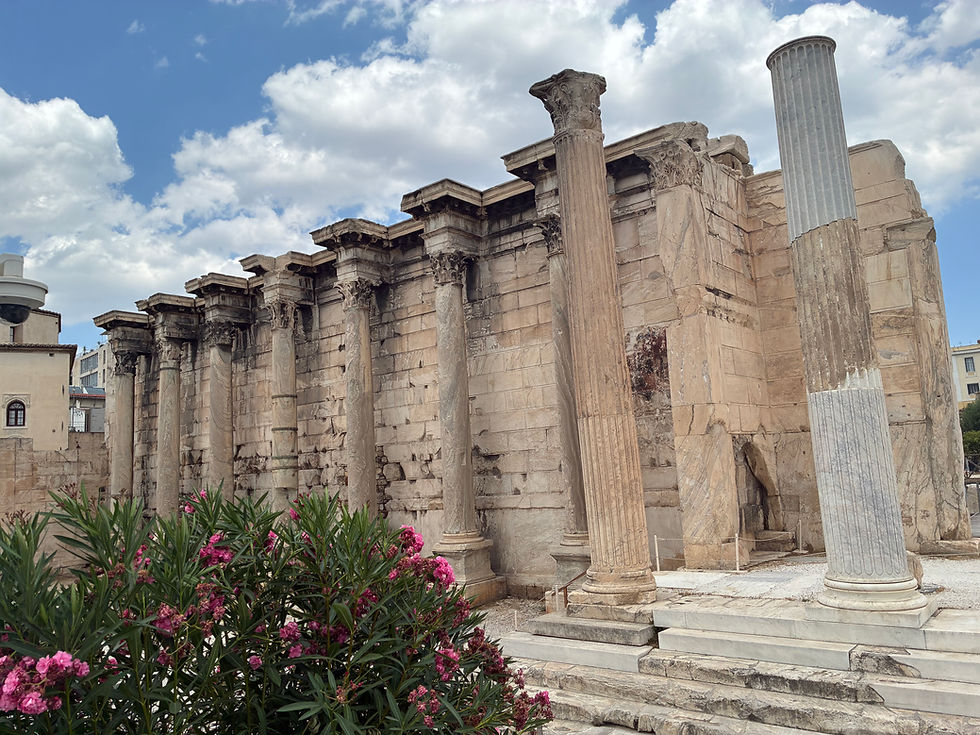
On our first day in Athens, my family and I were meandering through the neighborhoods surrounding the towering Acropolis. We saw ancient Orthodox churches dating back to the medieval times under the Byzantine Empire; mosques from the 1600s during the Ottoman occupation, and of course we also saw ancient Greek ruins lining the streets, with some built into newer structures above. As we walked around, something caught my eye: ancient Roman pillars lining a ruined structure. Immediately, I walked over to the entrance, my interest piqued, finding out it was the ruins of Hadrian's Library, which was not only a library but an extensive learning center dedicated to honoring Greek culture and history.
While today it’s in ruins, you can tell that the building was quite large, with dimensions of 400 by 270 feet and having more than 100 columns, of which only around 7 are preserved now. This building was part of Hadrian's efforts to restore Athens as the cultural capital of the Roman Empire in 132 AD, at the peak of his reign. The building housed various papyrus scrolls but also doubled as a center of debating, with an open courtyard for this very purpose. Hadrian not only built this library in Athens, but also took on many other building projects in the city. This begs the question of who this Hadrian guy is and why he loves Greece so much.

Hadrian reigned as emperor from 117 to 137 AD and was a part of the “Five Good Emperors” ( Nerva, Trajan, Hadrian, Antoninus Pius, Marcus Aurelius). He took over directly after Trajan, who governed over the empire at its greatest physical extent. Hadrian was mockingly coined Graeculus, meaning “ little Greek,” for his philhellenic tendencies and actions. As a child, he was obsessed with all things Greek, studying under Greek tutors, which then only boosted his admiration for the ancient society. He grew out a long beard like that of the ancient Greek philosophers, breaking the norm of emperors in the past being relatively clean-shaven. He was a trendsetter in this regard, as emperors for the next 100 years following him also carried on this act. Before becoming emperor, Hadrian served as archon or chief magistrate of Athens, probably where he first fell in love with Greece. Around 131-132 AD, he also created the Panhellenic League, a council/coalition of Greek cities, centered in Athens. I like to think that Hadrian felt a sort of nostalgia reading about the Peloponnesian League led by Sparta 400 years before and wanted to revive that in a way with Athens. Hadrian built his library–the inspiration for this post–, but he also finished building the massive Temple of Olympian Zeus–a construction that started half a millennium prior–, and it took over 600 years to build. The temple featured over 104 Corinthian-style columns, each a staggering 56 feet high. Inside the inner chamber of the temple, Hadrian erected a huge gold and ivory statue of Zeus paired with a statue of himself next to the god. Humble guy, right?

For the Romans, there are many other important sights in Greece outside Athens. A key example of this, and one of the places I visited, is the Oracle of Delphi in midwestern Greece. The oracle served as a communion with the gods, where leaders and regular people would come to see their fate or get a clue into how to do something. The priestess would have these elaborate visions, and it would then be the job of the priest to interpret these visions and give someone their prophecy or wisdom from the gods. The oracle played a huge role in Greek culture, as before any major war, leaders would go seek advice from the gods at the oracle on how they should carry out their war. The most notable instance of this is before the Persian War in the 5th century B.C. when the kings of Sparta went to the oracle and were told that one of them was going to die, which led to Leonidas volunteering himself and the story of the 300, which you probably know.

This blog is about ancient Rome, so how did Delphi play a role in their world? Even before the Romans took over Greece, ancient kings of Rome, like Tarquin the Proud, for example, visited the oracle in search of wisdom and prophecy. The oracle was consulted over the span of the Republic for guidance in the Punic Wars and by many generals like Sulla, Caesar, and Augustus for even just ordinary advice. It is said that Emperor Nero once visited the oracle and was told to “beware the 73rd year”, interpreting the message as his own 73rd year when in actuality it was referencing his successor, Galba, who was of age 73. Our friend Hadrian, of course, loved the Oracle, giving it a complete restoration under his rule, along withbringing back the beloved Pythian Games to the city. At the center of Delphi is the Temple of Apollo, god of music, prophecy, light, and many other things. In its prime, the Temple of Apollo was one of the largest temples in all of Greece. My family and I actually saw, in the central crypt of the temple, where scientists have recently found traces of a hallucinogenic gas that most likely caused these visions in the priestesses.

Ultimately, looking back on places like Hadrian's Library and the Oracle of Delphi puts everything into perspective: Rome might have conquered Greece on the battlefield, but Greece completely won over Rome with its culture and shaped the Roman Empire in its entirety. This Greek nostalgia is shown in every way of life, from Roman architecture to cuisine. Hadrian’s obsession with Hellenic life shows that you can't truly get the Roman Empire without first understanding the Greek foundation it was built on. Just as the Romans fell in love with the Greeks through their culture and ancient landmarks, I too felt a sprouting love for Greece and its wonderful history.
Cassius Dio, Roman History (Book 69)
Birley, Anthony R. Hadrian: The Restless Emperor (Routledge, 1997)


Comments